

AI in Academic Writing Between Innovation and the Threat to Originality
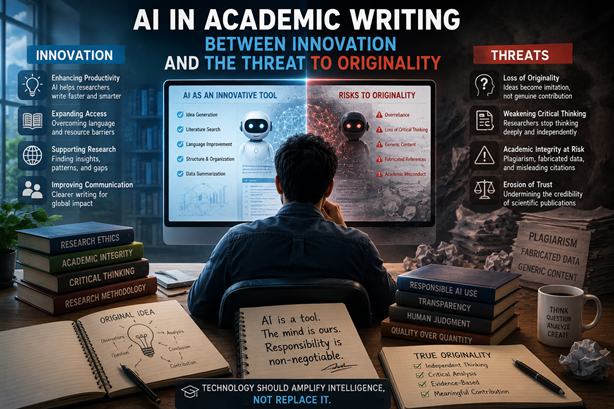
Artificial Intelligence (AI) is rapidly transforming the landscape of academic writing and scientific publication. Tools powered by generative AI have made it easier for researchers, lecturers, and students to search for information, organize ideas, improve language, summarize literature, and develop academic manuscripts. What once required considerable time and intellectual effort can now be accomplished within minutes. This technological advancement represents an important innovation in higher education, particularly for researchers who face increasing demands to produce scientific publications. However, behind this convenience lies a fundamental question that deserves serious attention: does the growing dependence on AI strengthen academic productivity, or does it gradually undermine the originality and intellectual integrity of scientific work? The issue is not simply about whether AI should be used in academic writing, but about how its use may reshape the meaning of authorship, knowledge production, and scholarly responsibility.
There is no denying that AI offers significant benefits when used appropriately. Researchers can employ AI to improve grammar, refine sentence structures, translate academic manuscripts, identify research gaps, and organize complex arguments. For scholars whose first language is not English, AI-assisted language editing can help overcome linguistic barriers and provide greater opportunities to participate in international academic discourse. AI can also support early-stage research activities by helping researchers explore concepts and generate preliminary ideas. In this sense, rejecting AI entirely would be an unrealistic response to technological change. Academic institutions should instead recognize AI as a supporting instrument that can improve research efficiency and accessibility. Nevertheless, technological efficiency should not automatically be equated with intellectual quality. A well-written manuscript is not necessarily an original contribution, and sophisticated language does not guarantee the validity of its scientific arguments.
The most serious concern emerges when AI moves beyond its role as an assistant and begins to replace the intellectual processes that constitute genuine academic work. Scientific writing is not merely the arrangement of sentences into coherent paragraphs; it is a process of questioning assumptions, evaluating evidence, interpreting findings, and constructing arguments based on systematic reasoning. When researchers rely excessively on AI to generate literature reviews, formulate research questions, interpret data, or develop conclusions without independent verification, they risk surrendering essential intellectual responsibilities. The resulting manuscript may appear academically sophisticated while containing superficial arguments, inaccurate interpretations, or unsupported claims. Such a practice creates an illusion of scholarly competence in which the appearance of knowledge becomes more important than the actual process of producing it. Ultimately, the danger is not that AI can write academic texts, but that researchers may gradually lose the willingness and ability to think critically for themselves.
Another critical issue concerns originality and academic integrity. Generative AI can produce convincing text by drawing on patterns learned from extensive collections of existing information. Although AI-generated text is not automatically plagiarism, its use raises important questions about intellectual ownership, attribution, and the authenticity of scholarly contributions. Researchers must be able to distinguish between using AI to improve the expression of their own ideas and allowing AI to generate substantial intellectual content that they subsequently present without adequate scrutiny or disclosure. Furthermore, AI systems can produce fabricated references, inaccurate citations, misleading statistics, and statements that sound authoritative but lack reliable evidence. These limitations are particularly dangerous in scientific publication, where every argument should be supported by verifiable sources and every research claim should be accountable to evidence. Therefore, originality must be understood not merely as the absence of copied sentences, but as the presence of independent thinking, authentic analysis, and meaningful intellectual contributions.
The increasing use of AI also presents a challenge to the credibility of the scientific publication ecosystem. Academic journals, editors, and peer reviewers are now confronted with manuscripts that may contain substantial AI-generated content, making the evaluation of authorship and originality increasingly complex. However, the solution should not be to establish a simplistic prohibition against all forms of AI assistance. Such an approach would fail to distinguish between responsible technological support and unethical academic practices. Instead, journals and universities need transparent policies that clearly define acceptable AI use, disclosure requirements, authorship responsibilities, and verification standards. Researchers must remain fully accountable for the accuracy, originality, and ethical quality of everything they submit, regardless of whether AI tools have been involved in the writing process. AI cannot assume authorship responsibility, defend research decisions, or be held accountable for scientific misconduct. Human researchers must therefore remain at the center of academic responsibility.
More importantly, the widespread adoption of AI should encourage universities to reconsider how academic competence and research productivity are evaluated. If academic success is measured primarily by the number of publications produced, the speed of manuscript completion, or the ability to meet institutional publication targets, AI may unintentionally reinforce a culture of quantity over quality. Researchers could become increasingly motivated to produce manuscripts quickly rather than develop substantial and original scientific contributions. This situation may intensify the existing pressures associated with the culture of “publish or perish.” Universities should therefore move beyond publication-oriented performance indicators and pay greater attention to research originality, methodological rigor, critical reasoning, ethical compliance, and societal impact. Academic institutions must also strengthen AI literacy among students and researchers, ensuring that technological competence is accompanied by ethical awareness and intellectual independence. The objective should not be to produce academics who can use AI to generate more publications, but scholars who can use technology responsibly to produce better knowledge.
Ultimately, the relationship between AI and academic originality should not be framed as a conflict between technological innovation and traditional scholarship. Rather, it should be understood as a challenge to redefine the boundaries of responsible knowledge production in the digital age. AI can accelerate academic processes, expand access to information, and help researchers communicate their findings more effectively. However, it cannot replace the intellectual curiosity, ethical judgment, contextual understanding, and critical reflection that give scientific research its meaning. The future of academic writing will depend not on how extensively researchers use AI, but on how wisely they integrate it into their intellectual practices. Technological advancement should strengthen human capacity rather than diminish it. Without clear ethical boundaries, AI may turn scientific writing into an exercise in automated text production. With responsible governance and critical engagement, however, it can become a powerful instrument for advancing knowledge.
The central challenge, therefore, is to ensure that AI remains a tool for innovation rather than a substitute for intellectual responsibility. Researchers must not confuse the ability to generate academic language with the ability to produce scientific knowledge. Universities, journal publishers, and policymakers share the responsibility of developing an academic culture that embraces technological progress while protecting originality, transparency, and integrity. Scientific publications should represent the researcher’s genuine intellectual contribution, not merely the technical ability to operate sophisticated digital tools. In an era when machines can increasingly imitate human academic writing, the most valuable quality of a researcher is not the ability to produce more words in less time, but the ability to think independently, question critically, and contribute something genuinely meaningful to human knowledge.




Tinggalkan komentar