

AI Can Write Articles but Cannot Replace Research Integrity
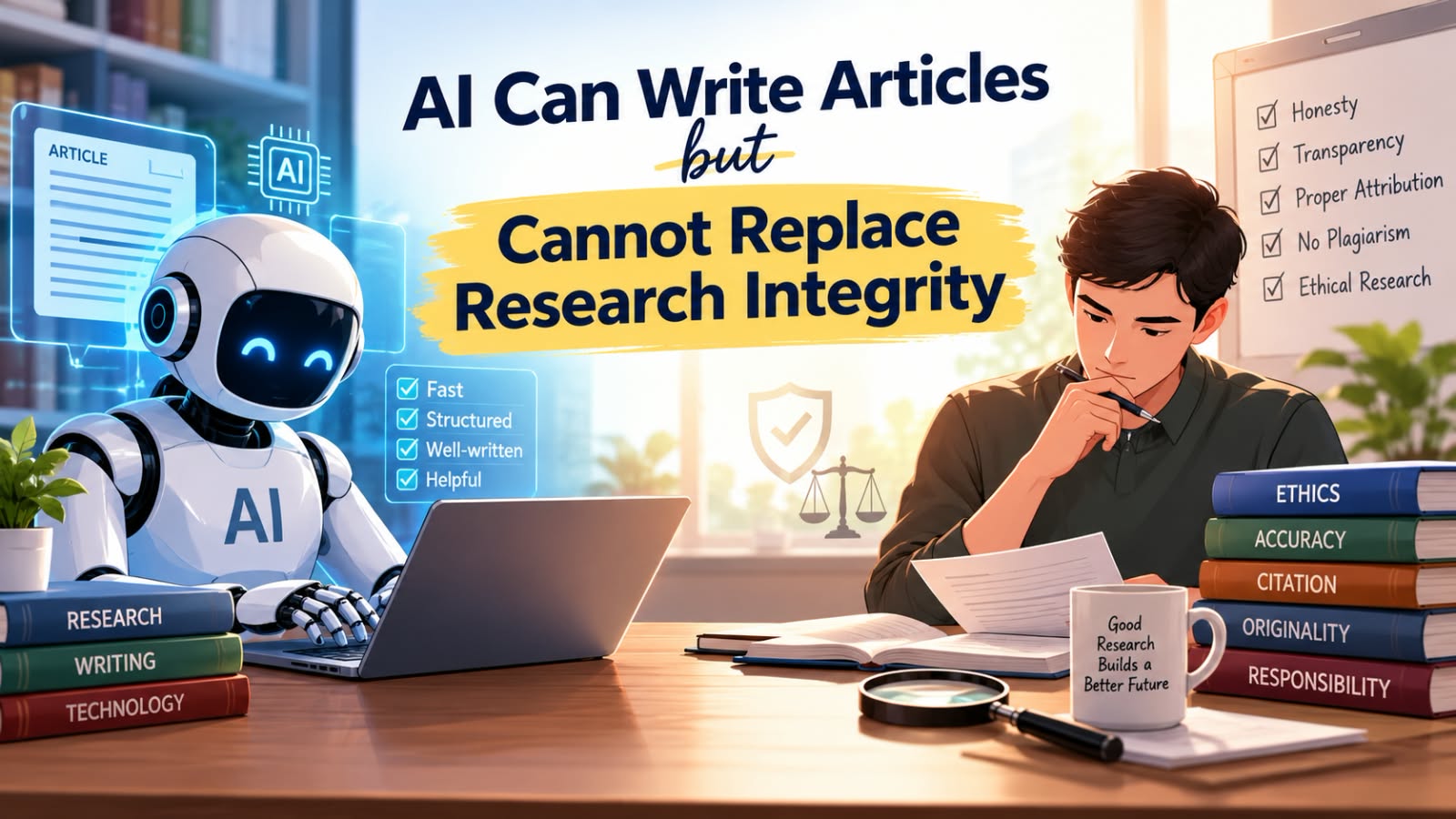
Artificial intelligence has changed the way academic knowledge is produced, distributed, and consumed. With a few carefully constructed prompts, researchers can now generate literature reviews, formulate research questions, summarize scholarly articles, and draft manuscripts in a matter of minutes. What once required weeks of intellectual labor can increasingly be completed in hours. Yet, behind this technological convenience lies a troubling question: if artificial intelligence can write an academic article, what exactly makes someone a researcher? The answer cannot simply be the ability to produce a manuscript. Research is not merely about arranging words into sophisticated paragraphs; it is about pursuing truth through systematic inquiry, intellectual honesty, and a willingness to be held accountable for the knowledge one produces. AI may accelerate academic writing, but it cannot automatically guarantee the integrity of the person using it.
The growing dependence on AI exposes a fundamental weakness in contemporary academic culture: the tendency to measure scholarly achievement through publication output rather than intellectual contribution. In many academic environments, lecturers and researchers face relentless pressure to publish articles, secure citations, improve institutional rankings, and meet promotion requirements. Under such circumstances, AI becomes more than a research assistant; it can become an instrument for satisfying administrative targets. The danger emerges when productivity becomes the ultimate objective and knowledge becomes secondary. Researchers may produce more manuscripts without necessarily conducting more meaningful investigations. The result is an academic paradox: universities may celebrate increasing publication numbers while overlooking whether those publications genuinely advance understanding, address societal problems, or withstand rigorous scholarly scrutiny.
However, blaming AI for the deterioration of academic integrity would be both simplistic and intellectually dishonest. Artificial intelligence does not independently determine whether a researcher will fabricate data, manipulate findings, misrepresent sources, or submit work that they do not understand. These decisions ultimately involve human judgment and institutional responsibility. AI can generate convincing explanations, but convincing language is not equivalent to verified evidence. It can suggest references that appear legitimate but may not exist, summarize findings inaccurately, or produce arguments that sound authoritative despite being conceptually weak. When researchers accept such outputs without verification, they surrender one of the most essential responsibilities of scholarship: the obligation to distinguish what is plausible from what is demonstrably true. The central problem, therefore, is not the existence of intelligent machines but the willingness of human beings to outsource their intellectual responsibility to them.
This challenge becomes even more serious when AI-generated content enters the publication process without transparent disclosure or adequate human supervision. Academic writing depends on traceability: readers must be able to identify the sources of claims, examine the evidence supporting conclusions, and evaluate whether the research methods justify the findings. When these foundations are compromised, the appearance of scientific rigor can conceal the absence of genuine inquiry. A manuscript may contain impeccable grammar, sophisticated terminology, and an impressive reference list while remaining methodologically unreliable. The danger is particularly acute when editors and reviewers are confronted with increasing numbers of manuscripts that are linguistically polished but intellectually superficial. If academic publishing rewards presentation more consistently than originality, methodological rigor, and reproducibility, AI will expose, not create the weaknesses already embedded in the scholarly ecosystem.
The responsibility for protecting research integrity must therefore extend beyond individual authors. Universities, journal editors, reviewers, publishers, and research funders all have a role in establishing standards that prioritize trustworthy knowledge over publication volume. Institutions should provide clear policies on acceptable AI use, require appropriate disclosure where necessary, and strengthen researchers’ understanding of research ethics and methodological accountability. Journal editors must assess manuscripts based on their intellectual contribution, evidentiary foundations, and methodological soundness rather than relying exclusively on stylistic quality or automated AI-detection scores. Such detection tools should not be treated as definitive evidence of misconduct because their results can be unreliable and may lead to unfair accusations. Above all, academic institutions must recognize that ethical research cannot be secured through surveillance alone. It requires a culture in which honesty is valued, misconduct is addressed fairly, and researchers are encouraged to prioritize quality over quantity.
Equally important is the need to reconsider the academic incentive system that makes unethical shortcuts attractive. When career advancement depends heavily on publication counts, journal rankings, and citation metrics, researchers may be tempted to pursue the fastest route to measurable achievement. This pressure can create favorable conditions for predatory journals, questionable authorship practices, superficial research, and the uncritical use of AI-generated manuscripts. The solution is not to prohibit AI indiscriminately but to reform the structures that reward academic appearance over substantive contribution. Promotion criteria should consider the originality of research, methodological quality, relevance to society, responsible collaboration, and the demonstrable contribution of individual scholars. Universities should also recognize teaching, community engagement, policy contributions, and the development of useful knowledge as meaningful academic achievements. A healthier academic system would allow AI to support research without turning scholarship into a race to accumulate publications.
For developing research ecosystems such as Indonesia’s, this debate carries particular significance. Access to AI tools can help researchers overcome language barriers, improve academic writing, organize literature, and participate more confidently in international scholarly conversations. Used responsibly, these technologies can broaden opportunities for scholars working with limited research resources. Nevertheless, technological access alone cannot resolve deeper inequalities in research funding, institutional support, methodological training, and publication opportunities. Nor should the ability to produce English-language manuscripts quickly be mistaken for the ability to conduct internationally competitive research. Indonesian universities must invest in research mentorship, reliable data management, ethical review, journal quality assurance, and sustained collaboration among scholars. The objective should not be to produce more articles at any cost, but to develop researchers capable of generating knowledge that is credible, relevant, and beneficial to society. AI should strengthen this mission rather than become another instrument of bureaucratic performance measurement.
Artificial intelligence forces academia to confront a question that technology cannot answer on its own: what does it mean to be intellectually honest? A responsible researcher does not merely produce a manuscript but understands its arguments, verifies its evidence, acknowledges its limitations, credits the contributions of others, and accepts accountability for its conclusions. AI can assist with language, analysis, and organization, but it cannot assume the moral responsibility attached to scientific claims. The future of academic publishing will not be determined simply by how sophisticated AI becomes, but by whether universities and researchers remain committed to the principles that give scholarship its legitimacy. The real threat is not that machines will learn to write like academics; it is that academics may become satisfied with writing that looks like research without doing the intellectual work that research demands. AI can write an article, but only researchers can be held accountable for its truth.




Tinggalkan komentar