

The Scopus Fever and the Shifting Priorities of Higher Education in Indonesia
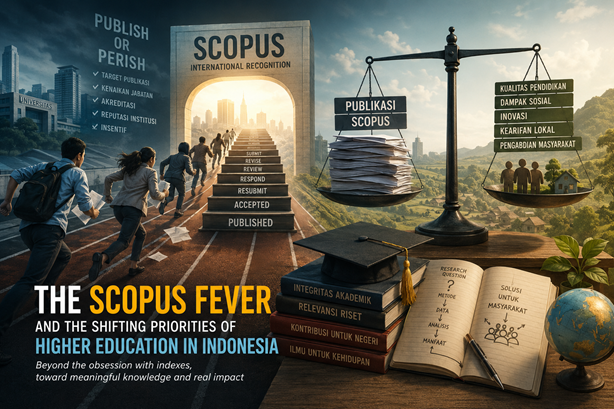
Higher education is fundamentally established to advance knowledge, cultivate critical thinking, and contribute to the betterment of society. Universities are expected to become centers of intellectual development, innovation, and social transformation. However, in Indonesia, the growing emphasis on international journal publications, particularly those indexed by Scopus, has gradually reshaped the priorities of higher education institutions. What was initially intended as an effort to improve research quality and strengthen global academic competitiveness has, in some cases, evolved into an excessive institutional obsession. This phenomenon can be described as the Scopus fever.
There is nothing inherently wrong with encouraging academics to publish in internationally recognized journals. In fact, international publications provide opportunities for Indonesian scholars to participate in global academic conversations, exchange ideas, and demonstrate the relevance of their research beyond national boundaries. Scopus indexing can serve as one indicator of journal visibility, academic reach, and scholarly recognition. Nevertheless, problems emerge when publication metrics become the primary measure of academic achievement, overshadowing the broader mission of higher education.
The fundamental question is not whether Indonesian academics should publish in Scopus-indexed journals, but whether the pursuit of such publications has become more important than the substance, relevance, and social impact of research itself.
When Publication Becomes More Important Than Knowledge
The growing pressure to publish internationally has created a distinctive academic culture in which publication quantity and journal rankings are increasingly associated with professional recognition, institutional reputation, promotion, and academic career advancement. In such an environment, academics may feel compelled to prioritize publishing articles in prestigious journals, sometimes at the expense of teaching, mentoring, community engagement, and long-term research development.
This situation reflects the well-known academic expression “publish or perish.” Although publishing is an essential component of scholarly development, excessive dependence on publication targets can transform research from an intellectual endeavor into an administrative obligation.
The danger is that academics may begin to ask, “Where can I publish this research?” before asking, “What problem does this research actually solve?” When this happens, the purpose of research risks shifting from generating meaningful knowledge to fulfilling institutional performance indicators.
Research should not merely produce articles that accumulate citations. It should also generate ideas, provide evidence for policymaking, address societal challenges, and contribute to technological, economic, cultural, and environmental development. A university’s academic excellence cannot be adequately represented by the number of articles published by its lecturers alone.
The Paradox of International Recognition and Local Relevance
Another important issue concerns the relationship between international publication standards and local research priorities. Indonesian academics operate within a society characterized by complex educational, economic, environmental, cultural, and technological challenges. These realities demand context-sensitive research that responds to the needs of local communities.
However, when international journal publication becomes the dominant academic objective, researchers may feel encouraged to select topics that are more attractive to international audiences rather than those that address pressing domestic problems. This does not mean that international research agendas are necessarily irrelevant to Indonesia. Rather, it highlights the need to maintain a balance between global academic engagement and national development priorities.
For example, research on rural education, local agricultural innovation, indigenous knowledge, regional economic development, and community-based environmental management may have enormous practical value for Indonesia. Yet, the contribution of such research should not be judged exclusively by its potential to appear in internationally indexed journals.
Indonesian universities must recognize that global academic visibility and local social relevance are not mutually exclusive. The strongest research should ideally connect both dimensions. It should be academically rigorous enough to contribute to international knowledge while remaining relevant to the communities and institutions that need its findings.
The challenge, therefore, is not to reject international publication, but to ensure that global recognition does not come at the expense of local responsibility.
The Commercialization of Academic Publishing
The Scopus fever also raises concerns about the growing commercialization of academic publishing. In the contemporary scholarly ecosystem, some journals require substantial article processing charges (APCs) for open-access publication. Although these fees can support editorial operations, peer review, and the dissemination of research, they may create financial barriers for researchers, particularly those working at institutions with limited research funding.
This situation creates an uncomfortable paradox. Academics are encouraged to publish internationally to demonstrate their research productivity, yet the financial requirements of publication may exceed their institutional resources. Consequently, the ability to publish can become influenced not only by research quality but also by access to funding.
More concerningly, the pressure to publish may expose inexperienced or highly pressured researchers to questionable publishers, predatory journals, and unethical publication services. The existence of such practices undermines the credibility of scholarly communication and threatens the integrity of academic institutions.
It is therefore essential to distinguish between genuine international academic recognition and the mere appearance of international prestige. A journal’s indexing status should never replace careful evaluation of its editorial standards, peer-review practices, scholarly reputation, and publication ethics.
Rethinking Academic Excellence in Indonesian Universities
The fundamental challenge facing Indonesian higher education is how to redefine academic excellence beyond publication metrics. Universities need performance evaluation systems that recognize the multidimensional nature of academic contributions.
Teaching quality, research originality, innovation, community engagement, interdisciplinary collaboration, policy contributions, and knowledge transfer should all become meaningful components of academic assessment. Publications remain important, but they should be evaluated based on their intellectual contribution, methodological rigor, relevance, and impact rather than simply their indexing status.
Furthermore, university leaders and policymakers need to create a research environment that supports quality rather than merely demanding output. This requires sustainable research funding, stronger research infrastructure, effective mentoring for early-career researchers, ethical publication support, and institutional collaboration.
Equally important is the need to strengthen research capacity before imposing ambitious publication targets. Researchers need sufficient time, resources, and intellectual freedom to identify important problems, develop robust methodologies, collect reliable data, and produce meaningful findings.
A publication culture cannot be built solely through incentives, rankings, and administrative regulations. It must emerge from a genuine academic ecosystem that values curiosity, intellectual integrity, critical inquiry, and the pursuit of knowledge.
Returning Higher Education to Its Intellectual Mission
The Scopus fever should encourage Indonesian universities to reflect on the direction of their academic development. International publication is undoubtedly valuable, but it should function as a means of advancing knowledge rather than becoming the ultimate objective of academic life.
A university that produces hundreds of internationally indexed articles but fails to address educational inequality, improve community welfare, generate meaningful innovation, or contribute to public policy must reconsider how it defines success. Conversely, research that creates tangible social benefits, even when it does not receive extensive international recognition, deserves serious academic appreciation.
Ultimately, the quality of higher education should not be determined solely by how frequently its academics publish in internationally indexed journals, but by how effectively universities generate knowledge, develop human potential, and contribute to society.
Indonesia needs universities that are globally connected but locally grounded, internationally recognized but socially responsible, and productive in publication without sacrificing intellectual integrity.
The real achievement of Indonesian higher education will not be measured by how many academics succeed in entering the Scopus database, but by how much meaningful knowledge they contribute to humanity. It is time to move beyond the Scopus fever and return to the true purpose of academic life: advancing knowledge for the benefit of society.




Tinggalkan komentar