

Study Program Development Strategies Based on Industry Needs and Digital Transformation
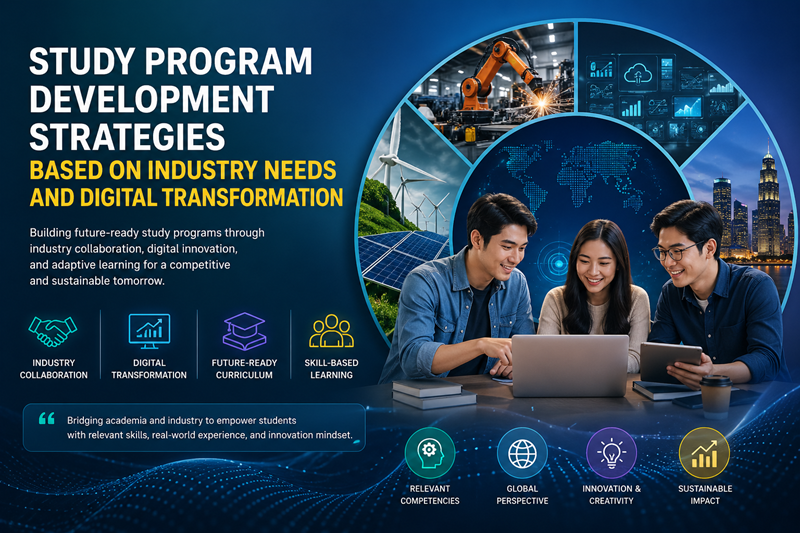
The conversation about higher education reform increasingly circles back to one unavoidable reality: industries are transforming faster than universities are adapting. From automation in manufacturing to data-driven decision-making in media and communication, the digital turn has reshaped how work is done, how value is created, and how professionals are evaluated. Yet many study programs still cling to curricular structures that were designed for a pre-digital era. This mismatch produces graduates who are knowledgeable in theory but unprepared for the demands of contemporary workplaces. Developing study programs based on industry needs and digital transformation is no longer a strategic option; it is an academic necessity.
A key issue lies in how study programs conceptualize relevance. Relevance should not be understood merely as adding a few technology-oriented courses into an old curriculum. Instead, it requires a structural rethinking of learning outcomes, teaching approaches, and assessment models. For example, communication students who once focused primarily on print journalism must now understand analytics dashboards, social media algorithms, and multimedia storytelling. Similarly, students in business programs need not only accounting skills but also familiarity with financial technology platforms and data visualization tools. The problem is not content addition, but paradigm revision.
Industry engagement must therefore move from ceremonial partnerships to substantive collaboration. Many universities proudly display memorandums of understanding with companies, yet these agreements rarely shape the curriculum in meaningful ways. A truly industry-informed study program invites practitioners into curriculum design workshops, integrates real case projects into coursework, and encourages students to solve actual organizational problems as part of their academic training. Internship programs should not be treated as complementary experiences but as integral components of learning. When industries become co-educators, the distance between classroom knowledge and professional practice narrows significantly.
Digital transformation also demands a shift in pedagogical methods. Traditional lecture-based instruction struggles to equip students with the agility required in digital environments. Project-based learning, collaborative assignments, and simulation-driven activities better mirror real workplace dynamics. For instance, students working in teams to design digital campaigns, analyze user data, or produce multimedia content develop both technical and soft skills simultaneously. These methods foster adaptability, problem-solving, and creativity, competencies that industries now prioritize over rote knowledge.
Another strategic dimension is faculty development. Study program reform cannot succeed if lecturers themselves are unfamiliar with emerging technologies and industry trends. Continuous professional development, industry immersion programs for faculty, and interdisciplinary collaboration are essential. When lecturers understand how digital tools are applied in professional settings, they can translate theory into relevant classroom experiences. Faculty members must evolve from being sole knowledge transmitters into learning facilitators who guide students through complex, real-world problem spaces.
Assessment systems also require redesign. Conventional examinations that emphasize memorization fail to capture students’ ability to apply knowledge in digital contexts. Portfolio-based assessment, project evaluation, and performance tasks offer more accurate measures of student competence. For example, a student’s ability to produce a data-driven report, create a digital marketing plan, or develop an application prototype reflects practical readiness far better than multiple-choice tests. Assessment, therefore, must align with the skills demanded by digital industries.
Study programs must anticipate future industry trends rather than merely respond to current demands. The rapid pace of technological change means that skills relevant today may become obsolete in a few years. Programs should cultivate learning agility, digital literacy, and interdisciplinary thinking so graduates can adapt continuously. Courses on artificial intelligence, data ethics, digital communication strategies, and innovation management are not luxuries but forward-looking investments in student resilience.
Developing study programs based on industry needs and digital transformation is about redefining the mission of higher education itself. Universities are not only centers of knowledge preservation but also engines of societal progress. By aligning curricula with digital realities and industry expectations, study programs can produce graduates who are not just job seekers but problem solvers, innovators, and leaders. In doing so, higher education fulfills its responsibility to remain relevant in an era defined by rapid technological evolution.




Tinggalkan komentar