

Digital Campus Transformation and Distance Learning
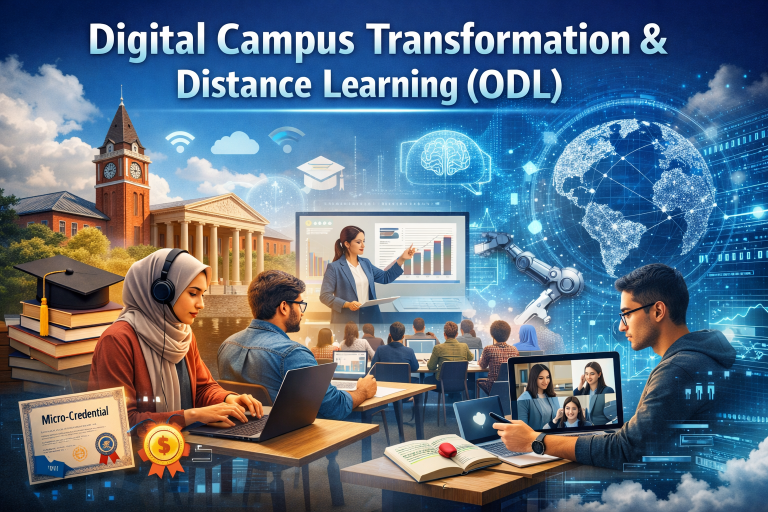
The transformation of the digital campus and distance learning (Pembelajaran Jarak Jauh/PJJ) is no longer a temporary response to crisis; it has become a structural shift in higher education. What began as an emergency solution during global disruptions has evolved into a redefinition of how universities conceptualize space, interaction, and knowledge production. The digital campus is not merely a physical campus supplemented by technology; it represents a reconfiguration of academic culture, governance, and pedagogical philosophy. Universities today are negotiating a new identity—one that blends physical presence with virtual connectivity.
At the heart of this transformation lies the logic of media convergence. As Henry Jenkins conceptualized in Convergence Culture, convergence is not just about technology but about the flow of content across multiple platforms and the migration of audiences. In higher education, this convergence manifests in hybrid classrooms, learning management systems, digital libraries, and synchronous-asynchronous communication platforms. The classroom is no longer confined to four walls; it is dispersed across screens, clouds, and digital repositories. Knowledge circulates in ways that transcend geographic and temporal boundaries.
From a pedagogical perspective, distance learning compels educators to rethink instructional design. The traditional lecture-centered model becomes insufficient in digital environments. Instead, interactive learning, project-based assignments, and collaborative knowledge construction gain prominence. Constructivist learning theory, particularly the ideas of Jean Piaget and Lev Vygotsky, becomes increasingly relevant in PJJ contexts. Students are not passive recipients of information; they actively construct meaning through discussion forums, digital simulations, and peer collaboration. The digital campus, therefore, can potentially democratize participation—if designed thoughtfully.
However, the promise of digital transformation also reveals deep structural inequalities. Access to stable internet, digital literacy, and adequate devices remains uneven, especially in developing contexts. The digital divide is not only technological but also socio-economic and cultural. When universities adopt PJJ without addressing these disparities, they risk reproducing exclusion under the banner of innovation. Thus, digital transformation must be accompanied by inclusive policies, infrastructure investment, and capacity building for both lecturers and students.
Another significant dimension of digital campus transformation is the rise of micro-credentials and modular learning pathways. Traditional degree structures are increasingly complemented by short-term certifications, digital badges, and competency-based modules. This shift aligns higher education more closely with labor market demands, emphasizing flexibility and lifelong learning. Yet, it also raises questions about the commodification of education. When learning becomes modular and market-driven, does it strengthen intellectual autonomy, or does it reduce education to workforce training?
The integration of artificial intelligence further complicates the digital campus landscape. AI-powered analytics can personalize learning experiences, detect academic dishonesty, and assist in curriculum planning. At the same time, it challenges conventional notions of authorship, originality, and assessment. Universities must navigate ethical frameworks to ensure that AI enhances critical thinking rather than replacing it. The goal should not be technological dependency, but technological literacy—empowering students to understand, critique, and responsibly utilize digital tools.
Institutionally, the digital transformation of campuses demands adaptive leadership and organizational restructuring. Governance systems must support agile decision-making, cross-departmental collaboration, and continuous technological upgrading. Faculty development becomes central, as lecturers transition from being knowledge transmitters to learning facilitators and digital mentors. Without institutional commitment and strategic vision, digital initiatives risk becoming fragmented experiments rather than sustainable reform.
Ultimately, Transformasi Kampus Digital & Pembelajaran Jarak Jauh is not simply about adopting new tools; it is about reimagining the philosophy of higher education. The university of the future must balance technological innovation with humanistic values, ensuring that efficiency does not overshadow empathy, and connectivity does not replace community. If managed critically and inclusively, digital transformation can expand access, foster creativity, and redefine academic engagement. If not, it may merely replicate old hierarchies in a new technological guise. The future of higher education depends on how wisely we navigate this transition.



Tinggalkan komentar